
Nobody navigates cancer alone.
Our nurse-navigator and our counsellors are taking calls now, ahead of the clinic opening. For patients, for the families around them, and for the doctors who refer them.
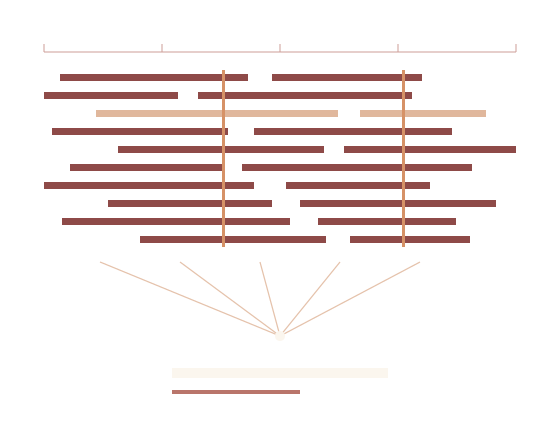
What happens when you get in touch
Five steps, in order. A navigator owns every one of the gaps between them, which is where most cancer pathways lose people.
The navigator and the counsellors
Two roles Indian oncology is thinnest on. Both are in-house and salaried at KPCIRC, and you can speak to either before you commit to anything.
The nurse-navigator
The one person who owns your case between appointments, which is the role most cancer pathways simply do not have, and the reason so much of the burden lands on families.
- Assembles your records before anyone sees you, so the first consultation is not spent hunting for reports
- Prepares the case for the tumour board, including the clinical summary, staging, pathology and imaging
- Coordinates scans, biopsies and procedures at partner facilities, and chases the reports back
- Holds the follow-up and surveillance dates, and calls you when one is due
- Is your point of contact if something changes between visits
Counselling
Three distinct kinds, none of them treated as an afterthought to the treatment.
- Genetic counselling — a three-generation family history, hereditary risk assessment, counselling before and after any test, and a written family letter for relatives who may need testing themselves
- Psycho-oncology — distress screening at diagnosis, and individual or family counselling through treatment and after it
- Financial and schemes counselling — what a plan will actually cost, which government schemes you qualify for, where a biosimilar or cost-aware equivalent exists, and help with the paperwork
Genetic counselling is a consultation. The germline test itself is ordered separately through OnKommon and billed separately, and the counsellor tells you what it costs before anything is sent.
Send a case. You remain the treating physician.
Refer for a specialist or cancer opinion, for molecular decision support, or to put a case in front of the board without moving the patient.
Open now, and not yet
The clinic opens on 1 September 2026. Rather than list everything the institution intends to become, here is what you can actually use.
Cancer risk assessment
A free assessment of your personal and family cancer risk, with a clear written next step. Advice only: no testing, no imaging and no diagnosis at this stage.
Genetic counselling
Hereditary risk assessment, counselling before and after testing, result interpretation, and a cascade plan for relatives who may be at risk.
Patient navigation
One named person coordinating the whole journey: records, appointments, partner procedures, and the follow-up dates afterwards.
Second opinion
A written opinion on an existing diagnosis and treatment plan, stating where we agree, where we do not, and the reasoning behind every option.
Molecular tumour board
A physician-led panel that reads the molecular profile alongside the clinical picture and agrees one written plan. Standing weekly from launch.
Psycho-oncology and family support
Distress screening at diagnosis, counselling for patients and for the people caring for them, and guidance on schemes and finances.
Specified and sequenced, not yet open
What we do not do here
We do not perform surgery, radiation therapy, imaging or laboratory procedures on site. Those are carried out by named partner facilities under your consultant direction, and we coordinate them for you.
We are not an emergency service. If you or someone you are caring for needs urgent medical attention, go to the nearest hospital emergency department rather than waiting for a reply from us.
Talk to a navigator
Tell us who you are and what you are facing. A navigator reads it and calls you back. This is not an automated queue.
Number to be published
Telephone
Number to be published
Monday to Saturday, 9am to 7pm
Where we are
Paschim Vihar, New Delhi
Consultations from 1 September 2026.
In an emergency, do not use this page. Go to your nearest hospital emergency department. Nothing on this site is a substitute for a clinical consultation, and no information here should be used to start, stop or change a treatment.