
The decision layer
Cancer treatment should be based on the whole case, not one report.
Ten inputs, one panel, one written recommendation. Precision oncology is not a machine and not a test. It is a way of deciding.
What goes in
Ten inputs, assembled before anyone decides
- Clinical assessment
- Tumour biology
- Pathology
- Imaging
- Genomics
- Treatment history
- Biomarkers
- Clinical trials
- Cost
- Patient factors
Most cancer decisions in India are made on one or two of these. Assembling all ten is slower and harder, and it is the entire difference between a treatment matched to your disease and a treatment matched to the average patient with your diagnosis.
Age, fitness, kidney and cardiac function, comorbidity, what you can travel to, what you can afford, and what you actually want out of treatment. A plan that ignores these is a plan the patient stops following.
How the decision is made

The consultation
What the first appointment covers
A long appointment, deliberately. It determines everything that follows.
Included
- Full assessment of the diagnosis, history, examination, staging review
- A decision on what molecular testing is genuinely required, and at what tier
- The likely option set, in language you and your family can follow
- A written patient summary you take away
- Listing at the tumour board, with a date
- A fertility conversation, for every patient of reproductive age, before treatment starts
Performed and billed elsewhere
- The molecular assay, ordered here, delivered and billed by OnKommon
- Surgery, radiotherapy and interventional work, at the partner facility you choose
- Imaging: CT, MRI, PET, ultrasound
- Day-care chemotherapy administration and admission
Clinical leadership
Dr Bharat Kwatra
Head of Computational Precision Oncology · MSc, PhD, MRSB, FRSM, aBGCI
Founder and clinical architect of KPCIRC and of OnKommon. Chairs the molecular tumour board and leads the computational side of the decision, interpretation strategy, evidence tiering and testing-tier selection.
Precision oncology session
Complex cancer cases, molecular decision-making and multidisciplinary review.
Offered as a package · quoted at booking
Book precision oncology session
SHOT LATER · IMG-PO-LEAD · 1200 × 1500 · 4:5
Genetics & family risk
The relatives nobody follows up
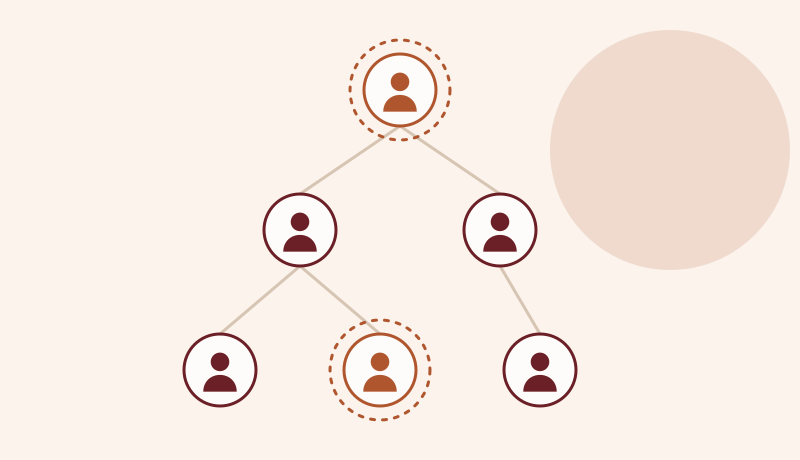
When a cancer carries an inherited component, the people most affected are often not the patient, they are the relatives who could be screened years before anything happens to them. This is where Indian practice most reliably fails: the variant is found, the family is told to "get tested", and nobody ever does.
- Three-generation pedigree, taken properly and recorded
- Pre-test counselling and separate written consent
- Result disclosure, including what an uncertain result does and does not mean
- A written cascade plan and a family letter you can hand to any relative's doctor
- A surveillance schedule for carriers, with recall built into our system
When a pathogenic variant is identified, the cascade plan enters our recall system with a named owner and scheduled contact dates. Somebody's job is to follow it up.
SHOT LATER · IMG-PO-02 · 1400 × 1050 · 4:3
SHOT LATER · VID-PO-01 · 60–90 s · Hindi and English
The team