 onkommon.com
Local therapy
Proton & heavy-ion therapy
Particle radiation that stops at a chosen depth instead of passing through.
Referral & opinion only
What it is
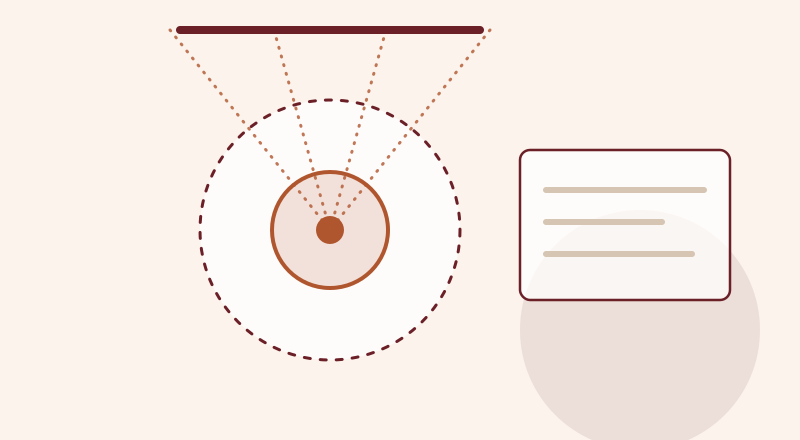
Protons deposit most of their energy at a set depth and then stop, so there is little dose beyond the target. That physical property is the whole argument for it, less radiation to tissue behind the tumour.
It is not automatically better. It is better in specific situations, chiefly where the tissue immediately behind the target is critical, and in children, where reducing lifetime dose matters most.
When it is used
- Selected paediatric tumours
- Tumours adjacent to critical structures, base of skull, spine, eye
- Re-irradiation in some settings
- Where the case for reduced dose to surrounding tissue is genuinely strong
How the decision is made
- Whether the physical advantage translates into a clinical one for your specific tumour and position. Frequently it does not, and we will say so.
- Access, very few centres in India offer it, and travel and cost are substantial.
- Whether a conventional stereotactic approach would achieve the same thing closer to home.
At a licensed particle therapy centre. Very limited availability in India.
Who does what
What we handle, and what happens elsewhere
KPCIRC handles
- An honest assessment of whether the advantage is real in your case
- Referral with a complete file where it is
- Board review
- Cost, travel and accommodation planning
- An alternative plan where it is not appropriate or not reachable
Performed and billed elsewhere
- Planning and delivery
- All travel, accommodation and centre charges
- Be cautious of proton therapy marketed as universally superior. The advantage is physical and situation-specific, not general, and the price difference is very large.
Questions to ask your own doctor
Take these with you. They work whether or not you are treated here.
- What specifically would protons spare in my case?
- Would stereotactic radiotherapy achieve something similar nearer home?
- What is the total cost including travel and staying there?
- Is there evidence in my tumour type?
Support that goes with it
Where this is used
Cancers this commonly forms part of
Brain & CNS tumours
Glioma, meningioma, and other central nervous system tumours
Childhood cancer
Cancers in children and adolescents
Sarcoma & bone tumours
Soft-tissue sarcoma, osteosarcoma, Ewing sarcoma, GIST
Oral, head & neck cancer
Mouth, tongue, cheek, gum, throat, voice box and salivary gland cancers
Not sure this is the right option for you?
That is exactly what a second opinion is for. Bring what you have, we will tell you what is missing and what the alternatives actually are, in writing.